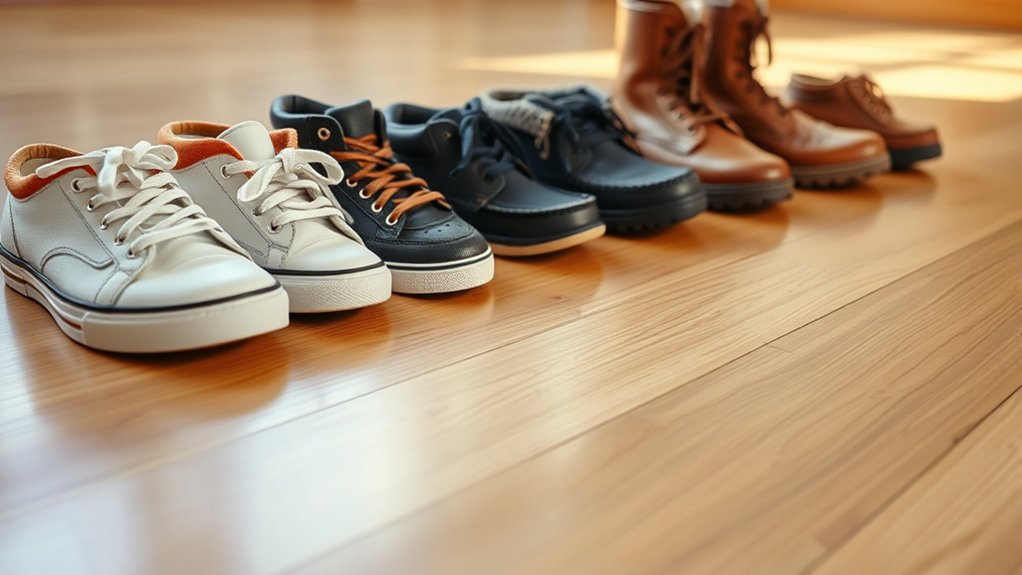
What Is the Size of Shoes
Shoe size primarily indicates your foot length, measured from heel to longest toe, but it doesn’t fully capture width or toe box flexibility. Understanding shoe size helps you find the right fit for comfort and support.
To get accurate sizing, place your foot on a flat surface with your heel against a wall, mark the longest point, and measure. Keep in mind that proper fit also depends on foot width, arch support, and material flexibility.
Since sizing varies internationally and across brands, understanding these details helps you find the best fit and avoid common sizing pitfalls.
Key Takeaways
- Shoe size primarily indicates foot length but does not fully account for width or toe box flexibility.
- Shoe sizes vary internationally, with different measurement systems like US, UK, European, and Japanese standards.
- Proper fit requires measuring foot length accurately by placing the heel against a wall and marking the longest toe.
- Foot width, arch support, and material flexibility significantly affect shoe comfort beyond just size numbers.
- Always consult brand-specific size charts and reviews for accurate fit, especially when shopping online internationally.
What Do Shoe Sizes Really Mean?
How do shoe sizes actually correspond to your foot’s measurements? Shoe sizes primarily indicate the length of the foot, but they don’t fully account for other critical dimensions like shoe width and toe box flexibility.
The width measurement is essential because it determines how snugly the shoe fits across the widest part of your foot. Ignoring this can lead to discomfort or even foot problems.
Toe box flexibility refers to how much space and movement allowance you have around your toes, impacting overall comfort, especially during extended wear or physical activity.
When selecting a shoe size, you should consider both length and width, alongside the design’s toe box flexibility, to ensure a proper fit that accommodates your foot’s unique shape and movement needs effectively.
How to Measure Your Foot Correctly
Properly determining your foot size goes beyond guessing or relying solely on standard shoe labels. To measure your foot correctly, focus on both foot length and toe shape, as these influence fit significantly. Follow these steps:
Place your foot on a flat surface with your heel against a wall. Mark the longest point of your foot (considering toe shape variations). Measure the distance from the wall to this mark to get your foot length.
Position your heel against a wall, mark the longest toe point, then measure the distance for accurate foot length.
Repeat the process for both feet, as one may be slightly larger. Use a rigid ruler or measuring tape for accuracy. Measuring at the end of the day ensures your feet are at their largest.
Recording both foot length and toe shape helps you choose shoes that accommodate your natural foot contours precisely.
What Factors Affect Shoe Fit Beyond Size
You need to contemplate factors beyond length when evaluating shoe fit, such as foot width, which affects comfort and stability.
Arch support plays a critical role in distributing pressure and maintaining proper alignment. Additionally, material flexibility influences how the shoe adapts to your foot’s movements throughout the day.
Foot Width Importance
Why does foot width matter as much as length when selecting shoes? Because an accurate fit depends on both dimensions. Ignoring foot width can cause discomfort, especially if you have a narrow toe or a wider forefoot. Shoes designed only by length won’t accommodate the lateral space your foot needs.
Consider these factors linked to foot width for optimal fit:
- Foot width varies widely among individuals, affecting pressure distribution.
- A narrow toe box may cause pinching or bunions if the shoe is too wide.
- Proper width prevents excessive foot movement, reducing blisters and fatigue.
- Shoe manufacturers often offer multiple width options (e.g., narrow, standard, wide) to address these differences.
Paying attention to foot width ensures your shoes support your foot’s natural shape, enhancing comfort and performance.
Arch Support Influence
Foot width plays a significant role in comfort, but the arch’s structure also directly influences how a shoe fits and supports your foot. Proper arch support aligns with your foot arch alignment, distributing pressure evenly and reducing strain.
When choosing shoes, you need to consider whether the arch support matches your foot’s natural curve, whether low, medium, or high arch. Incorrect arch support can cause discomfort, instability, and even long-term injuries.
Shoes with adjustable or built-in arch support help maintain proper alignment during movement, enhancing overall fit beyond just length and width measurements. By focusing on arch support, you ensure your footwear accommodates your foot’s biomechanical needs, improving comfort and reducing fatigue throughout daily activities or exercise.
Material Flexibility Effects
How does material flexibility influence shoe fit beyond mere size measurements? When you consider shoe fit, textile elasticity plays a crucial role by allowing the material to adapt dynamically to your foot’s shape and movements. This flexibility impacts how snugly the shoe conforms, affecting comfort and performance.
Fluid dynamics within the shoe’s interior, how air and moisture move, also affects fit by influencing temperature and preventing slippage.
Key factors include:
- Textile elasticity: Enables expansion and contraction for a custom fit.
- Material stiffness: Affects the shoe’s ability to accommodate foot shape changes.
- Breathability and moisture control: Driven by internal fluid dynamics, impacting fit stability.
- Deformation under stress: Determines how materials respond during walking or running.
Understanding these factors helps you select shoes that fit beyond size alone.
How Different Countries Size Shoes
Where do shoe size standards come from, and how do they vary internationally? Different countries use distinct measurement systems, such as the US, UK, European (Paris point), and Japanese sizing. Each system defines shoe length differently, influencing how manufacturers label their products.
When you engage in footwear marketing or shoe marketing, understanding these standards is essential for targeting global markets effectively. For example, the US and UK systems measure shoe length in inches but start at different base points, while the European system uses centimeters multiplied by two-thirds.
Japan employs a straightforward centimeter scale. These variations affect consumer expectations and inventory management. If you’re marketing shoes internationally, you must account for these sizing differences to guarantee accurate product information and reduce return rates.
How to Convert Shoe Sizes Across Systems
Understanding the differences in shoe size standards sets the stage for accurate conversions between systems. To convert shoe sizes effectively, you’ll need to reference detailed sizing graphs that compare measurements across regions. Keep in mind that shoe materials can influence fit, so conversions are approximate.
Recognizing shoe size standards is key for accurate conversions and accounting for material-based fit variations.
When converting sizes:
Use standardized sizing graphs to correlate foot length with system-specific numbers.
Measure your foot precisely in centimeters or inches before conversion.
Consider the shoe materials, as flexible materials may require less stringent sizing adjustments.
Account for half-sizes and width variations that may alter the sizing equivalence.
Why Do Shoe Sizes Vary Between Brands?
Why do your shoe sizes seem inconsistent across different brands? The main reason lies in the lack of universal brand consistency. Each manufacturer uses its own last, the mold shaping the shoe, which affects fit dimensions even within the same nominal size.
This variability creates sizing myths, like assuming size 9 in one brand matches another’s size 9 precisely. Additionally, brands interpret sizing standards differently, leading to discrepancies in length, width, and volume measurements.
Materials and design also influence perceived fit, complicating direct size comparisons. Understanding these technical factors explains why you can’t rely solely on numeric labels when switching brands.
Recognizing the limits of standardization helps you approach shoe sizing with realistic expectations and reduces frustration when encountering varied fits across different manufacturers.
How to Choose the Right Shoe Size Online
Since shoe sizes vary substantially between brands due to differing lasts and sizing standards, selecting the right size online demands a methodical approach. To overcome online shopping fears and barefoot measurement challenges, you need precise strategies.
First, measure your foot length and width using a ruler or measuring tape on a flat surface, preferably at the end of the day when feet are largest. Then, consult each brand’s specific size chart rather than relying on general conversions.
Consider customer reviews for insights on fit consistency. Finally, verify the return policy to allow easy exchanges or returns if the size isn’t right.
Use a standardized measuring method for accuracy
Compare exact measurements to brand size charts
Read reviews for real-world sizing feedback
Confirm flexible return/exchange policies
Frequently Asked Questions
How Often Should I Replace My Shoes for Foot Health?
You should replace your shoes every 300-500 miles to maintain foot health.
Recent fashion trends favor eco-friendly materials, so choose shoes combining durability with sustainable components to support both your feet and the environment effectively.
Can Shoe Size Change With Age or Pregnancy?
You might doubt it, but your shoe size can change due to age-related changes and pregnancy effects. Ligaments loosen, and swelling occurs, altering foot shape and size.
What Materials Make the Most Comfortable Shoes?
You’ll find comfortable materials like memory foam insoles and cushioned midsoles essential. Breathable uppers made from mesh or natural fibers improve airflow, reducing moisture and heat, which enhances overall shoe comfort during extended wear.
Are Custom-Made Shoes Worth the Extra Cost?
Custom-made shoes fit like a tailored glove, offering unmatched custom fit. While the price vs value ratio leans higher, you gain precise comfort and durability, making the investment worthwhile if you prioritize long-term foot health.
How Do Orthotics Affect Shoe Sizing and Fit?
Orthotics affect shoe sizing and fit by altering internal volume, so you’ll need to prioritize orthotics fit for sizing accuracy.
Adjust shoe size or width accordingly to maintain comfort and proper support when using custom or off-the-shelf orthotics.