How to Get Fitted for Running Shoes
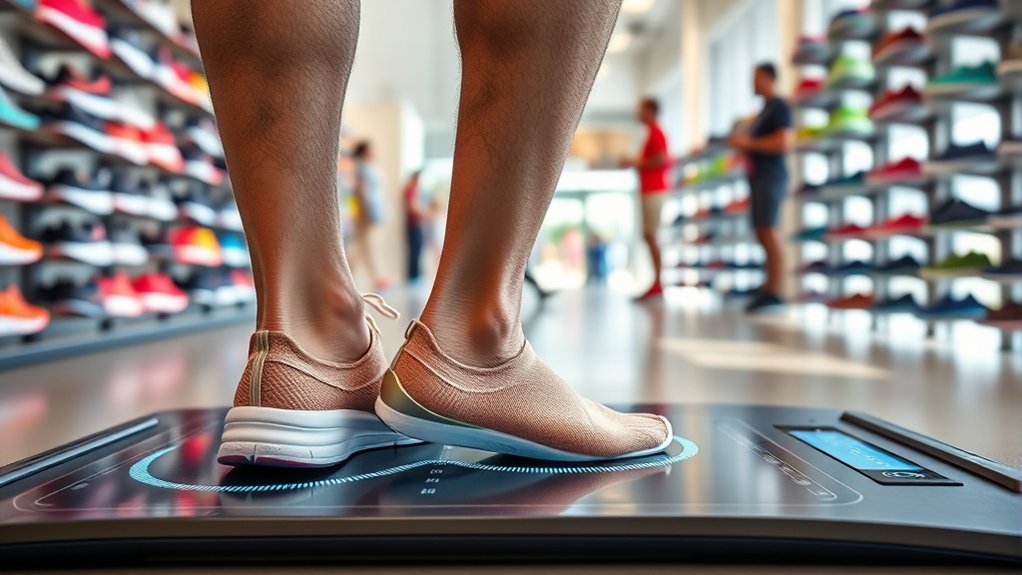
To get fitted for running shoes, start by measuring your feet while standing on a flat surface. Note both the length and width, ideally later in the day when your feet tend to swell. This ensures a more accurate fit.
Next, assess your foot type and arch by analyzing your footprint and gait. This helps determine the level of support your feet need. Understanding your biomechanics is key to selecting the right shoe.
When trying on shoes, choose ones that fit snugly without pinching. Test the flexibility where your toes bend and ensure stable fit around the heel and forefoot. Selecting a model tailored to your biomechanics optimizes comfort and performance.
Following these steps will equip you to make confident choices when buying running shoes.
Key Takeaways
- Measure foot length and width at the end of the day while standing to capture accurate, swollen foot dimensions for proper sizing.
- Identify your arch type using a wet test to match shoes with appropriate arch support and stability features.
- Test shoe fit by ensuring adequate toe box room, secure heel fit, and forefoot flexibility matching natural toe bend.
- Wear your usual running socks and orthotics during fitting, preferably in a store with flat, firm surfaces to simulate running conditions.
- Assess gait and pronation patterns to select shoes with suitable cushioning, stability, and durability for your biomechanics and terrain.
Why Proper Running Shoe Fit Matters for Your Comfort and Performance

Why does a proper running shoe fit play such a critical role in your comfort and performance? When your shoe fits correctly, it maintains optimal foot temperature by allowing adequate ventilation and reducing excessive heat buildup, which prevents discomfort and blisters.
A proper running shoe fit keeps your feet cool and blister-free by ensuring proper ventilation and temperature control.
A precise fit also ensures that your foot remains stable inside the shoe, promoting gait symmetry. This symmetry is essential for efficient biomechanics, reducing the risk of injury caused by uneven pressure distribution or misalignment.
Shoes that are too tight or loose disrupt your natural stride, negatively affecting your running economy. By prioritizing fit, you optimize force transfer and minimize energy loss, directly enhancing performance.
Ultimately, a well-fitted running shoe supports both comfort and biomechanical efficiency, enabling you to run longer and with less risk of injury.
How to Measure Your Feet Accurately for Running Shoes
How do you guarantee that your running shoes fit perfectly? Accurate foot measurement is essential for optimal shoe sizing. Follow these precise steps to measure your feet correctly:
Place your foot on a firm, flat surface with your weight evenly distributed. Trace the outline of your foot using a pencil, keeping the pen vertical.
Measure the length from heel to the longest toe and the width at the widest part. Take measurements at the end of the day when feet are most swollen.
Record both feet’s dimensions, as they often differ, using the larger measurement for sizing.
How to Identify Your Foot Type and Arch Support Needs for Running Shoes
When determining the right running shoes, understanding your foot type and arch support needs is essential. Start by evaluating your arch: low, neutral, or high, since it directly influences shoe stability requirements.
Understanding your foot type and arch support is key to choosing the right running shoes.
Use the wet test: wet your foot, step on a paper, and observe the imprint. A full imprint indicates low arches, needing motion control shoes; a moderate imprint shows neutral arches, favoring stability shoes; a narrow imprint reveals high arches, requiring cushioned shoes with flexible arch support.
Additionally, analyze your gait for pronation type to fine-tune support. Proper arch support minimizes injury risk and enhances comfort by aligning your foot’s biomechanics with the shoe’s design.
Identifying your foot type and arch support needs ensures you select running shoes that optimize performance and durability.
When Is the Best Time and Condition to Get Fitted for Running Shoes?
You should get fitted for running shoes later in the day when your feet are naturally swollen to their largest size. Wear the socks and orthotics you plan to use during running to guarantee an accurate fit.
Also, consider the store’s environment. Choose a location with a flat, firm surface and enough space to simulate your running stride.
Optimal Time of Day
Why does the time of day matter for getting fitted for running shoes? Your feet naturally swell throughout the day, affecting shoe fit. To ensure optimal comfort and performance, choose the right time for your fitting.
Aim to get fitted in the late afternoon or early evening, when foot swelling peaks.
Do so after a light walk or run, replicating your typical activity.
Wear the socks you plan to run in, ensuring proper fit.
Visit a store that practices good running etiquette, minimizing foot contamination.
Choose a place where shoe storage is well-maintained, preserving shoe structure and hygiene.
Fitting during these conditions helps you avoid tightness and discomfort, improving your running experience. Don’t underestimate how foot volume changes impact your ideal shoe size and fit.
Ideal Footwear Conditions
How do ideal conditions influence the accuracy of your running shoe fitting? The best time to get fitted is when your feet are at their largest, typically late afternoon or evening, because feet naturally swell during the day. This ensures the shoes accommodate your maximum foot size, preventing discomfort.
Wear the socks you plan to run in to replicate actual use conditions. Also, consider footwear aesthetics and color coordination carefully; selecting shoes that meet both functional and visual preferences increases satisfaction and likelihood of consistent use.
Avoid trying on shoes when your feet are cold or swollen beyond normal size, as this skews fit accuracy. By controlling these conditions, you optimize fit precision and ensure your running shoes perform well under typical usage scenarios.
Environmental Factors to Consider
When should you schedule your running shoe fitting to achieve the most accurate results? Environmental factors significantly influence foot measurements and comfort levels, so timing is crucial. Aim for late afternoon or early evening when your feet are naturally more swollen, reflecting their size during peak activity.
Also, consider sustainability considerations by choosing fittings at stores that prioritize eco-friendly materials and waste reduction.
Keep these points in mind:
- Test shoes after your typical running distance to simulate real conditions
- Wear moisture-wicking socks to assess breathability
- Ensure the fitting area is climate-controlled to mimic outdoor running
- Avoid fitting immediately after intense activity to prevent temporary swelling
- Opt for retailers with transparent sustainability practices
These steps ensure precise fitting aligned with environmental and sustainability factors.
What to Check During Your Running Shoe Fitting
What factors should you focus on during your running shoe fitting to ensure peak performance and injury prevention? First, accurate foot measurements are essential. Measure length, width, and arch height to select shoes that accommodate your foot’s unique structure.
Accurate foot measurements—length, width, and arch height—are crucial for selecting the right running shoes.
Check for adequate toe box space to prevent pressure points and allow natural toe splay. Evaluate the shoe’s midsole support relative to your arch type to enhance stability and shock absorption.
Pay close attention to shoe lacing. Ensure it secures your foot without causing tightness or restricting circulation. Proper lacing techniques can prevent heel slippage and improve overall fit.
Finally, assess the shoe’s heel counter to confirm it provides firm, snug support, minimizing excess movement that could lead to injury. These checks optimize fit and function before purchase.
How to Test Running Shoes for Comfort and Performance
To test running shoes for comfort and performance, start by ensuring the cushioning and support to assess they absorb impact effectively and align with your foot structure.
Next, evaluate the fit by checking for secure heel hold and adequate toe room without pressure points. Finally, test the shoe’s flexibility by bending it at the forefoot to confirm it moves naturally with your foot.
Assess Cushioning and Support
A critical step in evaluating running shoes involves assessing their cushioning and support to ensure optimal comfort and performance. You’ll want to focus on cushioning calibration, the shoe’s ability to absorb impact without sacrificing responsiveness.
Equally important is support balance, which stabilizes your foot during movement, preventing excessive pronation or supination.
When assessing these factors, consider:
- Press the midsole firmly to gauge cushioning density.
- Perform a heel-to-toe roll to test support consistency.
- Check for even pressure distribution across the footbed.
- Analyze the shoe’s arch reinforcement for lateral stability.
- Evaluate rebound by feeling how the shoe returns energy after impact.
This methodical approach ensures you select shoes that protect your joints and enhance running efficiency.
Evaluate Fit and Flexibility
How well a running shoe fits and flexes directly affects your comfort and performance on every stride. Start by ensuring the shoe accommodates your foot width without pinching or excess space.
Next, test the shoe’s flexibility by bending it at the forefoot. It should bend where your toes do, enabling natural motion. Check the tread grip by walking and running on different surfaces to confirm stability.
Use this table to guide your evaluation:
| Aspect | What to Check |
|---|---|
| Foot Width | No tightness or slipping |
| Flexibility | Bends at ball of foot, not midsole |
| Tread Grip | Firm, no slipping on varied surfaces |
| Overall Fit | Secure heel, comfortable toe box |
This process ensures the shoe supports your biomechanics and terrain needs efficiently.
How to Choose the Best Running Shoe Model for Your Foot Type
Because your foot structure directly impacts your running mechanics, selecting a shoe model tailored to your foot type is essential. Understanding your foot morphology through gait analysis helps identify whether you have a neutral arch, flat feet, or high arches, which influences shoe choice.
Look for models that offer:
- Adequate arch support matching your foot morphology
- Cushioning suited to your gait impact patterns
- Stability features for overpronators or supinators
- Lightweight design for efficient biomechanics
- Durable outsole materials for your typical running surfaces
Using data from gait analysis ensures the shoe aligns with your pronation and strike pattern, reducing injury risk. Prioritize shoes that complement your unique foot shape and motion characteristics to optimize comfort and performance.
How to Safely Break in Your New Running Shoes
Start by gradually introducing your new running shoes during shorter sessions to allow the materials and fit to adjust to your feet. This phased approach aids in comfort testing, enabling you to identify pressure points or fit issues early.
Monitor how the shoe’s upper and midsole respond to your foot’s movement, as this affects material durability. Avoid extended runs initially to prevent blisters or discomfort caused by unyielding new materials.
Increase wear time incrementally, allowing the shoe’s cushioning and support structures to conform to your gait. Pay attention to any signs of premature wear or stiffness, which may indicate insufficient break-in or a need for a different model.
Frequently Asked Questions
How Often Should I Replace My Running Shoes?
You should replace your running shoes every 300 to 500 miles, depending on your replaceable mileage and shoe lifespan.
Monitor sole wear and cushioning to ensure optimal performance and injury prevention throughout the shoe’s functional timeframe.
Can Running Shoes Help Prevent Specific Injuries?
Carefully considering shoe wear patterns can support injury prevention by ensuring proper support and alignment. You’ll benefit from reduced risks like plantar fasciitis or shin splints, as tailored running shoes stabilize stride and absorb shock effectively.
Are Expensive Running Shoes Always Better Quality?
Expensive shoes aren’t always better quality; that’s a common misconception. You should evaluate materials, construction, and fit rather than price alone.
Sometimes mid-range shoes offer superior durability and support tailored to your specific running needs.
How Do Weather Conditions Affect Running Shoe Choice?
“Don’t put all your eggs in one basket.” You’ll want shoes with weather considerations like waterproofing or breathability for terrain adaptation. Choose soles suited for wet, dry, or icy conditions to maintain traction and comfort precisely.
Can I Use Running Shoes for Other Sports?
You can use running shoes for other sports, but shoe fit and activity versatility matter. Running shoes prioritize forward motion and cushioning, so they might lack lateral support needed for sports requiring quick side-to-side movements or stability.
Conclusion
Getting the right fit for your running shoes isn’t just about comfort—it’s about optimizing your performance and protecting your feet from unnecessary strain. By measuring accurately, understanding your foot type, and testing shoes under proper conditions, you’re setting yourself up for success.
Remember, choosing the right model and breaking them in gently ensures your feet won’t face any “unexpected challenges” on the road. Take these steps seriously, and your runs will thank you.
Ultimately, getting fitted for running shoes properly is key to enjoying every mile with confidence and ease.