How Do You Draw Jordan Shoes
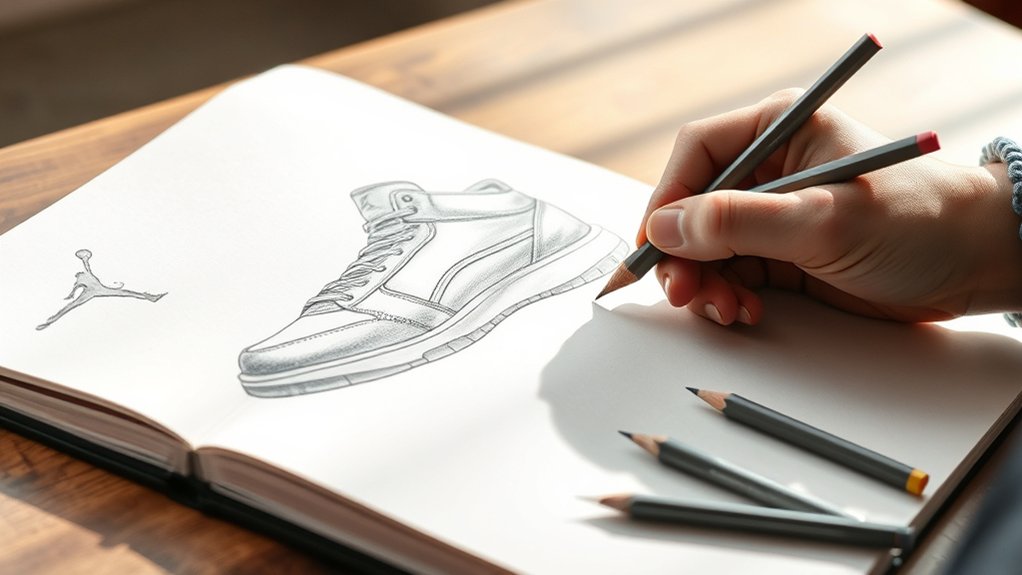
To draw Jordan shoes, start by blocking out the silhouette with basic geometric shapes like ovals and rectangles to capture proportions and structure accurately. Use light strokes to outline form, then add shading to define volume and material differences such as mesh and leather.
Layer in logos and stitching precisely by referencing multiple angles for authenticity. Focus on clean edges and consistent lighting to enhance realism.
With further guidance, you’ll refine details and master signature Jordan textures and colors.
Key Takeaways
- Start by sketching the shoe’s silhouette using basic geometric shapes like ovals and rectangles to establish proportions and structure.
- Use light strokes to outline curves, angles, and the thick sole before refining details and maintaining silhouette accuracy.
- Apply shading to define volume, depth, and material differences like leather and mesh, consistent with a single light direction.
- Reference high-quality images to accurately place logos, stitching, and sole patterns, ensuring proper proportions and symmetry.
- Gradually build textures and surface details, layering lines and shading to distinguish materials without overpowering the shoe’s form.
How to Sketch the Basic Shape of Jordan Shoes
How do you begin capturing the iconic silhouette of Jordan shoes? Start by assembling silhouettes using basic geometric shapes: ovals for the sole, rectangles for the midsole, and curves for the upper. Focus on proportions: the thick sole and high ankle collar define the shoe’s structure.
Use light, controlled strokes to outline the shoe’s form before refining. Once the silhouette’s established, move to sketching textures, carefully indicating mesh, leather, and rubber by varying line weight and patterns.
Pay attention to subtle details like perforations and stitching lines, as these add depth and realism. By methodically assembling silhouettes and applying precise sketching textures, you’ll create a technically accurate foundation for your Jordan shoe drawing that captures its distinctive look without overcomplicating your initial sketch.
How to Use References to Improve Your Jordan Shoe Drawings
Why rely on references when drawing Jordan shoes? Using references guarantees accuracy in proportions and details, helping you capture authentic design elements. When you practice consistency, referencing multiple angles improves your understanding of the shoe’s form and structure.
Pay attention to materials selection in your references; different textures require different shading techniques. Maintain lighting consistency across your references to achieve realistic depth and dimension.
| Aspect | Importance | Tip |
|---|---|---|
| Using references | Ensures accurate details | Use multiple images from angles |
| Practice consistency | Develops uniformity in sketches | Regularly compare your drawings |
| Materials selection | Affects texture representation | Focus on leather, mesh, rubber |
| Lighting consistency | Enhances 3D form and shadows | Use references with similar light |
| Angle variety | Provides comprehensive perspective | Collect side, top, and front views |
How to Add Key Details Like Logos and Stitching
You’ll need to position logos with exact proportions and alignment to maintain authenticity. Focus on replicating the stitching patterns by observing stitch length, direction, and spacing carefully.
These details bring your Jordan shoe drawing to life with precision and realism.
Placing Logos Accurately
Where exactly should you position the logos to maintain the authentic look of Jordan shoes? Precise logo placement is essential for silhouette accuracy. Begin by identifying the shoe model, as each has specific logo locations, commonly on the ankle collar, tongue, heel, and sole.
Use reference images to measure proportionally, ensuring logos are neither oversized nor misplaced. Align logos symmetrically on both shoes to preserve balance. Pay attention to logo orientation; the Jumpman or “Wings” logo must face the correct direction relative to the shoe’s profile.
When sketching, mark these positions lightly before finalizing to avoid errors. Accurate logo placement enhances the shoe’s identity and helps replicate its distinctive silhouette, giving your drawing authenticity and professional polish.
Drawing Realistic Stitching
To capture the intricate texture and craftsmanship that stitching adds to Jordan shoes, begin by studying the exact stitch patterns and their placements. Use fine, controlled lines to replicate individual stitches, paying close attention to their spacing and direction.
Apply shading techniques to suggest depth and thread thickness, layering subtle gradients to mimic the raised texture. Employ color theory by selecting thread colors that contrast slightly with the shoe material, enhancing visibility without overpowering the design.
Utilize highlights sparingly to indicate light reflection on the threads. Be precise with stitch curvature, especially around seams and logos, to maintain realism. This methodical approach ensures your drawing reflects the authentic craftsmanship and detailed texture that make Jordan shoes iconic.
Common Mistakes to Avoid When Drawing Jordans
Why do some Jordan shoe drawings fail to capture the authentic look? One common mistake is neglecting accurate color blocking. Jordans rely on precise placement of colors to define their iconic style, so mismatched or poorly segmented areas disrupt the shoe’s identity.
Another frequent error involves rendering material texture inaccurately. Each part of the shoe, leather, mesh, suede, has distinct surface qualities that affect light reflection and shadow. Over-smoothing or inconsistent texture application flattens the design, losing depth and realism.
Additionally, overlooking the shoe’s proportions or exaggerating curves can distort its recognizable silhouette. To avoid these pitfalls, focus on analyzing reference images carefully and replicate the interplay of color blocks and textures with deliberate brushwork or pencil strokes. This precision ensures your Jordans look authentic and visually compelling.
How to Choose Materials and Tools for Drawing Jordans
Mastering the authentic look of Jordan shoes depends not only on your observation skills but also on selecting the right materials and tools. Begin with material selection: opt for smooth, heavyweight paper to handle detailed shading and layering without warping.
Choose graphite pencils ranging from 2H to 6B to capture both fine lines and deep shadows accurately. Incorporate colored pencils or markers with high pigmentation for vibrant color fidelity. Prioritize tool ergonomics. Select pencils and brushes with comfortable grips to reduce hand fatigue during intricate detailing.
Use fine-tip mechanical pencils for precision edges and blending stumps for seamless gradient transitions. Quality erasers, like kneaded or precision-tip, help refine highlights without damaging the paper. Thoughtful material selection combined with ergonomic tools enhances your ability to render Jordans with technical accuracy and artistic finesse.
How to Pick the Right Jordan Shoe Model to Draw
Which Jordan shoe model should you choose to draw first? Start by selecting a model with distinctive shapes and clear contours, like the Air Jordan 1. This helps you focus on how to study proportions accurately, ensuring each section, from the sole to the upper, maintains correct scale and placement.
Analyze reference images meticulously, noting the shoe’s unique curves and panel layouts. When you understand these proportions, you can decide how to exaggerate features to emphasize style or movement without distorting the shoe’s identity.
Avoid overly complex models initially, as intricate designs can obscure proportional study. Prioritize models that balance detail with clarity, allowing you to hone technical precision while experimenting with feature exaggeration for a dynamic, yet faithful representation.
How to Capture Signature Jordan Colorways With Shading and Color
How do you accurately translate the iconic Jordan colorways into your drawing? Start by analyzing the shoe’s color blocking, the distinct sections of contrasting colors that define each model. Use precise color matching to replicate these blocks faithfully.
Incorporate metallic accents carefully, applying subtle highlights to mimic reflective surfaces without overpowering the design. Employ shading techniques that correspond with your light source, enhancing volume and texture while maintaining perspective accuracy.
Avoid flat coloring; instead, layer gradients to convey depth. Ensure your shading respects the shoe’s curves and contours to preserve three-dimensional realism.
Effective Practice Techniques to Improve Your Jordan Shoe Drawings
You should start by sketching the basic shoe shapes to establish accurate proportions and structure. Concentrate on key details like the sole patterns and iconic logos to enhance realism.
Always use high-quality reference images to guide your lines and shading with precision.
Sketching Basic Shoe Shapes
Where do you begin when capturing the complex form of Jordan shoes? Start by mastering sketching fundamentals. Block out the shoe’s silhouette using simple geometric shapes like rectangles and ovals.
This framework guides proportions and balance. Focus on the shoe’s overall form before adding details. Employ basic shading techniques early to define volume and depth, using light strokes to distinguish planes.
Precision here avoids later distortions.
| Step | Focus Area | Technique |
|---|---|---|
| 1 | Basic silhouette | Use geometric shapes |
| 2 | Proportions | Measure key dimensions |
| 3 | Volume | Apply light shading |
| 4 | Curves & angles | Refine shape outlines |
| 5 | Depth | Contrast shading zones |
This methodical approach ensures your sketches stay structurally sound and visually accurate.
Focusing on Key Details
Having established the shoe’s fundamental shape and volume, the next step targets refining the drawing by emphasizing key details. You need to focus on the intricate design elements that define Jordan shoes, such as panel stitching, sole texture, and logo placement. This precision comes from consistent practice anatomy, understanding the shoe’s structural components and their spatial relationships.
Additionally, mastering lighting effects enhances depth and realism, so observe how light interacts with different materials like leather and mesh.
- Analyze the contours and seams for accurate line placement
- Highlight textural contrasts with subtle shading variations
- Apply lighting effects to accentuate form and volume
- Refine logo and branding details with crisp edges
- Study sole patterns to replicate tread intricacy
This approach sharpens your technical skills and elevates your drawing’s authenticity.
Using Reference Images
How exactly can reference images transform your approach to drawing Jordan shoes? When you study references, you gain precise insight into the shoe’s structure, materials, and unique design elements. This lets you sketch simple outlines that capture the shoe’s essence before adding intricate details.
Using reference images ensures accuracy in proportions and textures, improving your overall technique.
| Step | Action |
|---|---|
| 1. Select Image | Choose clear, high-res photos |
| 2. Analyze Shape | Focus on silhouette and angles |
| 3. Sketch Simple | Draw basic forms and outlines |
| 4. Add Details | Layer textures and logos carefully |
Frequently Asked Questions
Where Can I Buy Authentic Jordan Shoes for Drawing Inspiration?
You can buy authentic Jordan shoes for inspiration sources at official Nike stores or verified retailers. Always perform authenticity checks by examining materials, stitching, and holograms to ensure genuine quality before using them as drawing references.
What Is the History Behind the Design of Jordan Shoes?
The history design of Jordan shoes is like a blueprint evolving with precision; you’ll see design evolution driven by performance needs, innovative materials, and cultural influence. This creates iconic silhouettes balancing form, function, and basketball heritage seamlessly.
How Do Jordan Shoes Compare to Other Sneaker Brands in Design?
You’ll find Jordan shoes excel in design aesthetics through bold lines and innovative materials, while their brand storytelling integrates Michael Jordan’s legacy. This sets them apart with precise craftsmanship and emotional resonance unmatched by most sneaker brands.
Are There Digital Tools Recommended for Drawing Jordan Shoes?
You’ll want digital drawing software like Adobe Illustrator for precision and Procreate for flexibility, plus 3D modeling tools such as Blender or Autodesk Fusion 360 to create detailed, accurate, and textured Jordan shoe designs efficiently.
Can I Sell Artwork of Jordan Shoes Commercially Without Permission?
You can’t sell Jordan shoe artwork commercially without permission due to copyright basics protecting trademarks. Explore licensing options from rights holders to legally distribute your work.
This ensures compliance with intellectual property laws and helps you avoid infringement risks.