How to Choose Running Shoes Arch Support
To choose running shoes arch support effectively, start by identifying your arch type. You can do this using a simple wet test or by seeking a professional foot scan. Knowing your arch type is crucial for selecting the right shoes.
Next, pick shoes that offer cushioning and stability features tailored to your arch. For low arches, stability shoes are ideal. Neutral shoes work well for medium arches, while cushioned shoes suit high arches best.
When trying on shoes, check the insole pressure to ensure even distribution. This helps confirm the fit supports your arch correctly. Finally, maintain proper support by regularly inspecting insoles and replacing them when they wear out.
Understanding these factors ensures comfort and helps prevent injuries. You’ll find detailed guidance to perfect your selection next.
Key Takeaways
- Identify your arch type using the wet test or digital scanning to determine low, neutral, or high arches.
- Choose shoes with appropriate arch support: stability shoes for low arches, neutral for normal arches, and cushioned for high arches.
- Look for shoes featuring responsive midsoles, durable breathable materials, and stability elements like medial posts or dual-density foam.
- Test shoe fit by checking insole pressure distribution and ensuring even support along the arch to prevent hotspots.
- Maintain arch support by regularly inspecting insoles, rotating them, and using custom orthotics if needed for precise alignment.
How to Identify Your Arch Type for a Better Shoe Fit
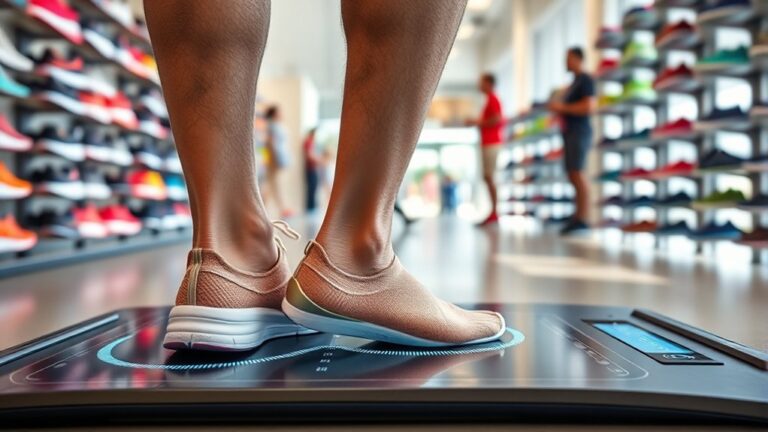
How can you determine your arch type to ensure the best running shoe fit? Start with a proper arch assessment to evaluate your foot’s structure accurately. One common method is the wet test: dampen your foot, step onto a flat surface, and examine the footprint.
A full imprint indicates a low arch, a narrow band suggests a high arch, and a moderate imprint reflects a neutral arch. You can also consult a podiatrist or use digital scanning tools for precise measurements.
Understanding your arch type directly influences your fit perception, ensuring the shoe supports your foot’s unique biomechanics. Avoid relying solely on visual cues or generic sizing.
Accurate arch assessment improves comfort, reduces injury risk, and optimizes your running experience by matching shoe support to your foot’s profile.
Why Arch Support Really Matters When You Run
Why does proper arch support play a crucial role in your running performance and injury prevention? Arch support directly influences your running biomechanics by maintaining correct foot alignment and distributing pressure evenly. Without it, inefficient biomechanics can cause excessive strain and lead to injuries.
Proper arch support ensures correct foot alignment, improving biomechanics and reducing injury risk during running.
Here’s why arch support is crucial:
- Stabilizes your foot during ground contact, enhancing balance.
- Reduces overpronation or supination, preventing joint stress.
- Improves shock absorption, minimizing impact forces.
- Supports energy transfer, increasing running efficiency.
Features to Look for in Running Shoes With Arch Support
What qualities should you prioritize when selecting running shoes with effective arch support? First, focus on shoe material that combines durability with breathability, such as engineered mesh or synthetic overlays, to maintain structural integrity while allowing airflow.
The midsole should feature responsive cushioning, often made from EVA or polyurethane, to provide consistent arch support without sacrificing comfort. Next, consider the shoe’s stability features, like medial posts or dual-density foam, which help control overpronation and reinforce arch support.
Additionally, examine the shoe’s price range carefully; higher-priced models typically incorporate advanced materials and technologies, but effective support can also be found in moderately priced shoes if they meet your biomechanical needs. Prioritize these technical features to ensure your running shoes deliver alternative arch support and performance.
How to Test Running Shoes for Proper Arch Support
To test running shoes for proper arch support, start with the wet test method by wetting your foot and stepping on paper to observe your footprint.
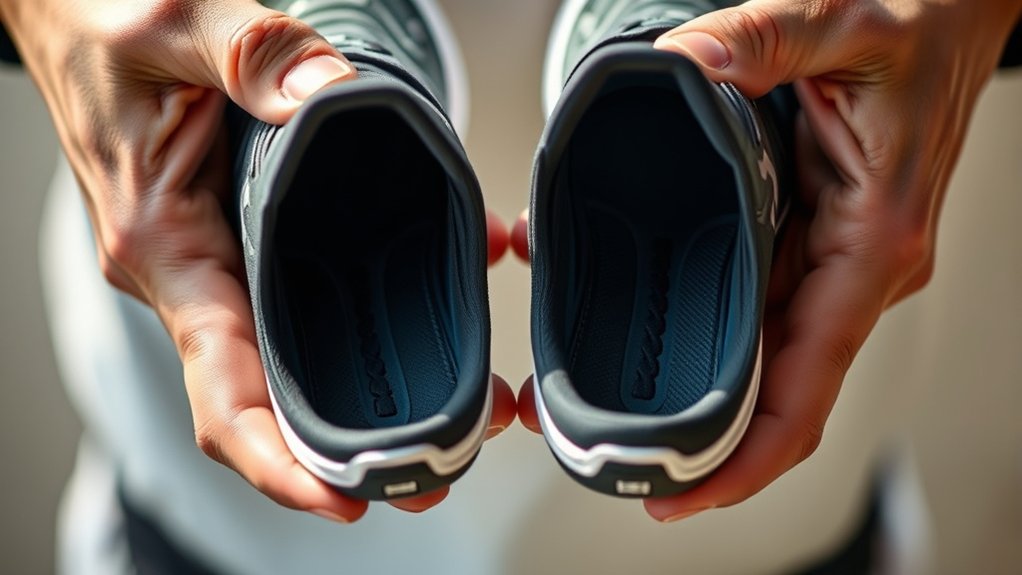
Then, perform an insole pressure check by pressing your hand firmly into the shoe’s insole to feel the arch contour and support level. These tests help you assess whether the shoe’s design matches your arch type effectively.
Wet Test Method
How can you quickly assess whether your running shoes provide adequate arch support? The wet test offers a simple, effective way to perform arch mapping of your footprint, helping you evaluate shoe fit. Here’s how to do it:
- Wet the sole of your foot evenly.
- Step firmly on a piece of paper or cardboard.
- Observe the footprint’s shape and note the arch area where there’s less contact.
- Compare this print to your shoe’s insole shape to determine if it supports your arch correctly.
A clear wet test print reveals your arch type: high, normal, or flat. Matching this arch mapping with your running shoe’s support features ensures better alignment and reduces injury risk. Use this quick method before committing to a shoe purchase.
Insole Pressure Check
Once you’ve identified your arch type using the wet test, the next step involves evaluating how your running shoe’s insole distributes pressure across that arch. To perform an insole pressure check, place the shoe on a flat surface and step inside, ensuring your foot rests naturally.
Focus on areas where you feel excessive pressure or lack of support. Proper arch alignment is indicated when pressure is evenly distributed along the arch area without concentrated hotspots.
You can also use pressure-sensitive mats or insoles designed to reveal pressure points for a more precise assessment. If you notice uneven insole pressure causing discomfort or misalignment, consider trying shoes with enhanced arch support or custom insoles to maintain biomechanical efficiency and reduce injury risk during runs.
Tips for Maintaining Arch Support as Your Shoes Wear Down
You should inspect your insoles regularly to identify any loss of arch support early. When you notice wear, replace them or add supportive shoe inserts designed to maintain proper alignment.
These steps help preserve arch stability and prevent injury as your shoes age.
Inspect Insoles Regularly
A pivotal step in maintaining ideal arch support is to inspect your insoles regularly, especially as your running shoes begin to show signs of wear. Monitoring insoles durability helps prevent compromised arch support and potential injury. Perform an arch height assessment during inspection to ensure the insole’s contour still matches your foot’s arch.
Follow these steps:
- Remove insoles and check for compression or deformation.
- Compare arch height to your foot’s natural curve; noticeable flattening signals wear.
- Examine material integrity; cracks or thinning reduce support.
- Rotate insoles between shoes to extend durability and monitor wear patterns.
Use Supportive Shoe Inserts
How can you maintain optimal arch support as your running shoes naturally degrade over time? One effective method is to use supportive shoe inserts specifically designed to reinforce arch support. Running inserts provide targeted cushioning and structural integrity that compensates for the gradual compression of your shoes’ midsoles.
By selecting inserts crafted from durable materials like EVA foam or gel, you ensure consistent shock absorption and arch stabilization during your runs. Additionally, custom orthotic inserts can be tailored to your foot’s arch profile, offering precise biomechanical support.
Regularly replacing running inserts prevents diminished arch support, reduces injury risk, and prolongs your shoes’ functional lifespan. Incorporating supportive shoe inserts into your routine is a practical, technical solution to maintain optimal arch support as your running shoes wear down.
Best Running Shoes for Different Arch Types
Which running shoe suits your arch type can considerably impact your performance and injury risk. To optimize shoe fit and support, identify your arch type first: low, normal, or high. Each requires specific shoe characteristics:
- Low Arch (Flat Feet): Choose stability shoes with firm medial support to prevent overpronation.
- Normal Arch: Opt for neutral shoes that provide balanced cushioning and support.
- High Arch: Select cushioned shoes that enhance shock absorption and flexibility.
- Custom Orthotics: Consider inserts tailored to your arch type for precise support and improved shoe fit.
Matching shoes to your arch type ensures proper alignment, reduces strain, and enhances running efficiency. Always test the fit by running short distances before committing to a purchase. Your arch type dictates the shoe structure that best supports your biomechanics.
Frequently Asked Questions
Can Arch Support Shoes Help With Knee Pain?
Think of your body as a finely tuned machine; arch support shoes can realign your knee, reducing arch pain and improving knee alignment.
This helps decrease stress on joints, potentially easing knee pain during movement.
How Often Should Running Shoes Be Replaced?
You should replace running shoes every 300-500 miles, depending on wear and arch support degradation.
Monitor sole cushioning and structural integrity, as compromised arch support can reduce performance and increase injury risk.
Keep track diligently.
Are Custom Orthotics Better Than Standard Arch Support?
Custom orthotics are the secret sauce for personalized comfort, offering tailored support based on your foot’s unique shape.
Standard arch support works for many, but custom orthotics provide precise correction and improved biomechanics for optimum performance.
Can Improper Arch Support Cause Foot Blisters?
Yes, improper arch support can cause foot blisters by increasing friction and pressure points. This misalignment may also lead to knee pain due to altered gait mechanics, so choosing proper arch support is essential for injury prevention.
Do Arch Support Shoes Affect Running Speed?
Arch support acts like a tuned engine, stabilizing your foot’s mechanics. Proper arch support can improve running speed by enhancing efficiency and reducing fatigue.
Poorly fitted support may disrupt your stride and slow you down.